Tywin Lannister
A Clash of KingsTywin Lannister is presented less through private conversation than through the consequences of his commands. From Catelyn Stark’s perspective, he is the true danger behind Ser Gregor Clegane’s atrocities; from the movement of armies and fleets, he emerges as a patient strategist who turns violence, geography, and political alliances into instruments of power. Even when he is absent from the immediate scene, other characters measure their choices against him.
Identity and Position
Tywin Lannister is Lord of Casterly Rock, Warden of the West, father to Queen Cersei Lannister, Ser Jaime Lannister, and Tyrion Lannister, and grandfather to the newly crowned Joffrey Baratheon. His authority is therefore simultaneously dynastic, territorial, and military. Catelyn Stark identifies him as the source of the danger threatening the riverlands, placing his familial connection to the king beside his control of the western armies and his influence over the queen’s regime.
His power is repeatedly associated with secure strongholds. Tywin sits behind the walls of Harrenhal while his host consumes the riverlands’ harvest and burns what it cannot carry away. The fortress gives him protection, supplies, and a commanding position from which to pressure his enemies without exposing himself to unnecessary risk. His apparent distance is thus not passivity; it is the condition from which his strategy operates.
Agents of Terror
Tywin’s warfare reaches the countryside through commanders and irregular forces. Ser Gregor Clegane is described as one of the dogs Tywin has loosed, while Ser Amory Lorch and a sellsword from Qohor operate elsewhere in the field. Their violence includes burning villages, rape, mutilation, and the abandonment of butchered children to attract wolves and wild dogs. The destruction is not treated as random disorder. It is part of the atmosphere Tywin creates around his war, making whole communities experience Lannister power before any formal battle arrives.
The death of Darry, still only a child and the last of his line, sharpens the moral and political meaning of this violence. Catelyn knows Gregor’s reputation, but refuses to reduce the conflict to the punishment of a single monster. In her judgment, Clegane is merely Tywin’s catspaw. The distinction matters because it shifts responsibility from the visible perpetrator to the lord who releases and uses him.
Strategy and the Choice of Battlefield
Tywin’s immediate objective is to provoke the riverlords into a battle favorable to him. Brynden Tully explains that terror has a purpose: Tywin wants to make his opponents march on Harrenhal. The campaign’s atrocities are therefore also bait. By inflicting suffering, he aims to enrage Edmure Tully and intensify pressure on Robb Stark, whose recent victories have made his bannermen eager for further action.
Brynden’s first rule of war is never to give the enemy his wish, precisely because Tywin wants to fight on ground of his own choosing. This description defines Tywin’s method more clearly than a battlefield boast would. He does not merely seek victory through superior force; he works to shape the decision that brings the enemy within reach of that force. His strategy joins provocation to positional advantage, turning his opponents’ anger and confidence into possible instruments against themselves.
The contrast with Robb Stark is pointed. Robb has smashed Jaime Lannister at the Whispering Wood and routed Jaime’s leaderless host outside Riverrun in the Battle of the Camps, leading some bannermen to speak of him as if he were Aegon the Conqueror reborn. Yet those victories also make him restless and encourage others to urge him onward. Tywin’s pressure exploits exactly this tension between triumph and overconfidence: the more Robb’s followers believe in his momentum, the easier it may become to lure him into the kind of confrontation Tywin prefers.
War Machine and Political Consequences
Tywin’s influence is visible in the preparations surrounding the wider war. When he finally marches, Arya Stark witnesses a castle transformed into a military workshop: wagons are loaded with wine, flour, and arrows; smiths repair weapons and armor; mail is scoured in barrels of sand; cloaks are mended and washed; tents and pavilions are dismantled. The departure of Ser Addam Marbrand, one of Tywin’s captains, precedes the rest of the army and displays the disciplined pageantry of Lannister command.
Arya’s response is hatred rather than admiration. She hopes Addam Marbrand and his men die because she knows they are going to fight Robb. Rumors reach her that Robb has won a major victory in the west, with conflicting versions claiming that he has burned Lannisport, captured Casterly Rock, or besieged the Golden Tooth. The uncertainty itself shows how military information circulates through Tywin’s world: armies move before ordinary observers understand what has happened, while rumor converts distant operations into immediate fear.
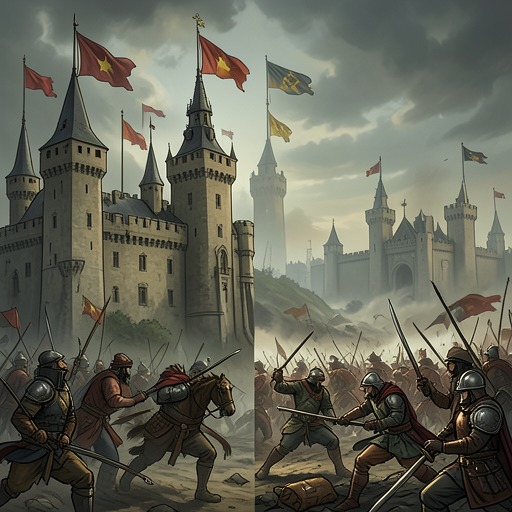
Tywin’s preparations eventually become decisive at the Battle of the Blackwater. Ser Dontos describes the relief of King’s Landing when Tywin’s allied forces arrive through the ashes of the burning river and attack Stannis Baratheon’s army from the rear. The attackers come along the riverbank and through fields burned by Stannis, their armor turned grey by the ash. Tywin commands the right wing on the north side of the river, while Randyll Tarly commands the center and Mace Tyrell the left; the vanguard breaks through Stannis’s army with overwhelming force.
The victory is not solely a Lannister achievement. The banners of Highgarden and Casterly Rock appear together with those of the western and allied houses, including the Marbrand tree, Rowan’s sigil, Tarly’s huntsman, Redwyne’s grapes, and Lady Oakheart’s leaf. Tywin’s importance lies in his ability to gather and direct this concentration of power at the critical moment. His intervention turns a city under imminent threat into a defended political center and leaves Stannis’s host slaughtered, scattered, or forced to yield.
Narrative Role and Significance
Tywin functions as an unseen organizer of danger. Catelyn’s grief over Eddard Stark’s execution and the spectacle of Ned’s head on a spike above the walls of the Red Keep intensify her conviction that Tywin, rather than Gregor alone, represents the central threat. His name gathers together dynastic ambition, military calculation, and the suffering inflicted on civilians.
The character is also defined by contrast between absence and effect. At Harrenhal he is physically protected while the countryside is ravaged; before the Battle of the Blackwater he is not among the immediate witnesses who fear the city’s fall, yet his arrival determines its survival. The narrative makes power legible through movement around him: captains depart, armies burn fields, enemies debate whether to march, and allies assemble under banners. Tywin’s authority is consequently less a matter of personal display than of causation. What others do, fear, or hope for becomes evidence of the reach of his will.